Stick Run Survival Guide: Mastering Jumps, Double Jumps & Rolls
In-depth breakdown of every obstacle in Stick Run. Learn frame-perfect timing for crates, saws, glass barriers, and gaps.
 Stick Run Team
The Core Philosophy of Stick Run
Stick Run is deceptive in its simplicity. With only two main inputs—Jump (Up Arrow ↑ / W) and Slide (Down Arrow ↓ / S)—it boils the platformer runner genre down to raw reaction time and rhythmic discipline. Because the character moves forward at an ever-accelerating pace, your decisions must be made fractions of a second before the stickman reaches an obstacle.
In this guide, we break down each major hazard and the exact timing windows you need to achieve high-score runs.
1. Wooden Crates & Box Towers
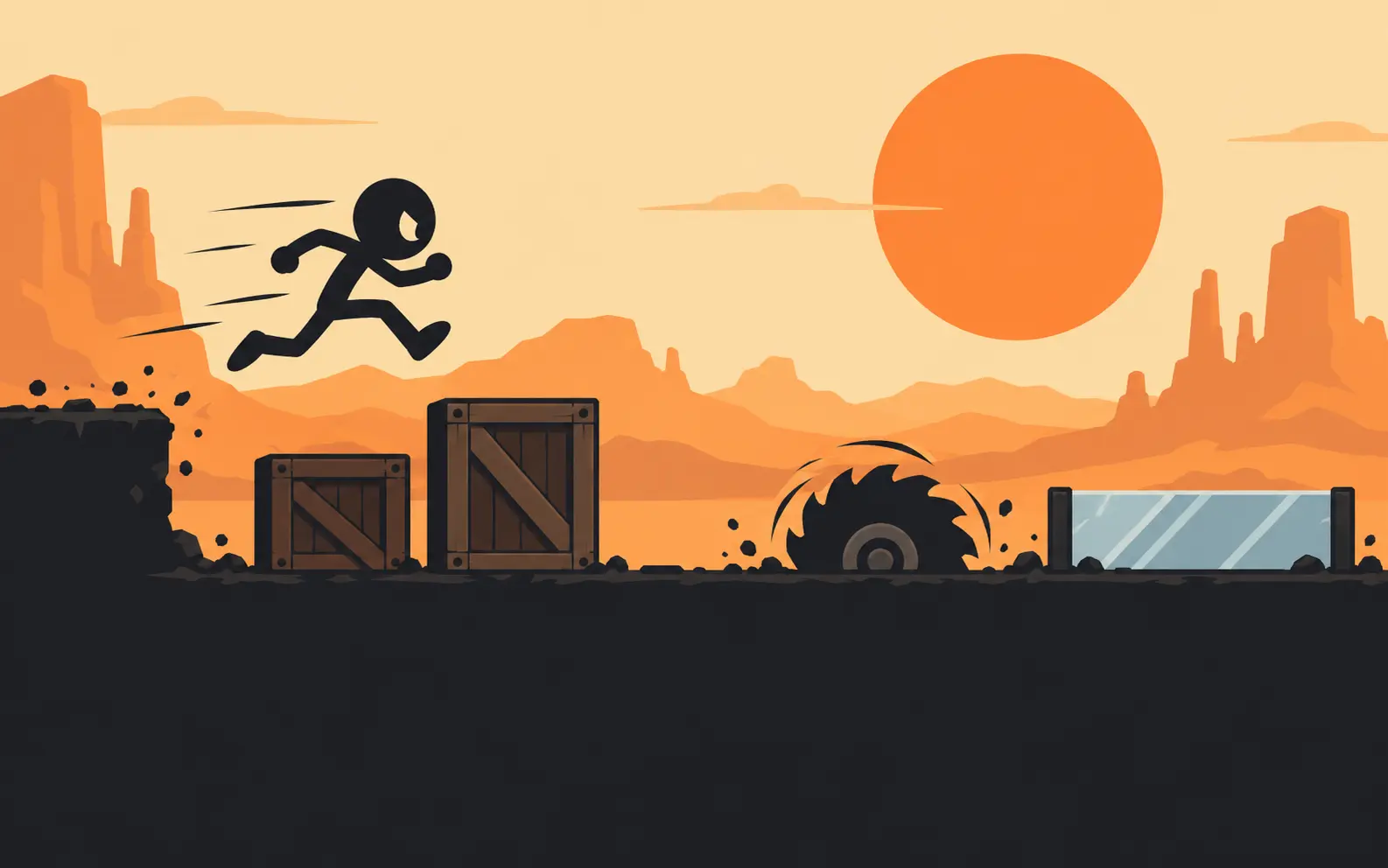
Crates are the foundational obstacle in Stick Run. They appear as single blocks, double-stacked crates, or extended pyramids.
- Single Crates: Tap Jump right as you approach the crate. A standard single jump easily clears the height.
- Stacked Crates (2-High): You must execute a Double Jump. Press Jump once at the base, and press Jump again at the peak of your initial arc to gain maximum vertical clearance.
- Stepping Stone Strategy: Unlike saws, you can land safely on top of wooden crates. If your jump was mistimed and you land on a crate surface, immediately jump again to clear the next hurdle without taking frontal collision damage.
2. Rotating Circular Saws
Sawblades are completely lethal from every single angle—including above. You cannot land on top of a saw.
Golden Rule: Always prioritize wide clearance over tight jumps when saws are involved. If you spot a saw right after a crate, preserve your second jump to adjust your aerial trajectory mid-flight.
3. Low-Hanging Glass Panes
Glass barriers force you down rather than up. When a low translucent glass pane appears, holding the Down Arrow (Roll/Slide) makes the stickman slide along the floor.
- Slide Duration: Stick Run gives you a generous sliding window, but getting up too early while still under the glass triggers a fatal collision.
- The "Slide-into-Jump" Combo: One of the toughest sequences is a glass barrier followed immediately by a pit or saw. Keep the slide held until your torso passes the glass edge, then flick straight to Jump.
4. Chasm Gaps & Precision Landings
As your distance exceeds 1,500 meters, floor gaps become wider and more frequent.
- Wait Until the Ledge: Resist the panic reflex to jump early. Running all the way to the cliff edge before triggering your first jump maximizes horizontal coverage.
- Buffer the Double Jump: Do not spam double jump instantly. Delay the second tap until your vertical momentum begins to crest downward to catch a second burst of lift.
Top 3 Mental Rules for 2,000+ Meters
- Look Ahead, Not at the Stickman: Train your eyes to focus on the rightmost third of the game screen. If you are watching your stickman, you are reacting too late.
- Respect the Rhythm: Obstacles generate in algorithmic waves. Recognize when a "rest stretch" is ending so a sudden saw doesn't catch you off-guard.
- Stay Relaxed: Physical tension slows down finger reflex time. Keep your hands resting comfortably on the keyboard.